


THE CHALLENGE
You only know what your data shows

THE DIFFERENCE
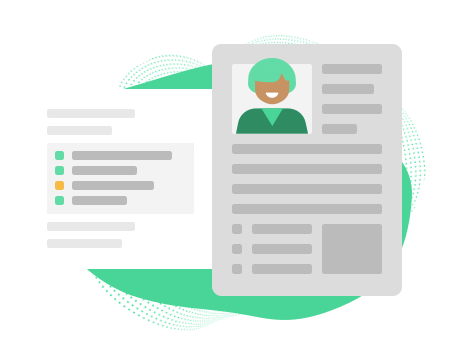
Get the document, not just the alert
Before Clinical Alerts:
- An alert lands. Your team re-queries to retrieve the document. The clock keeps running.
With Clinical Alerts:
- The alert arrives with the source document already linked, stored, and tied to the patient chart.
THE OUTCOME
Coordinate more efficiently with more knowledge
Clinical Alerts allow you to:
● Monitor an entire population or a high-risk cohort
● Trigger care management workflows automatically
● Improve transitions of care
● Expand visibility beyond a single facility
● Detect activity across inpatient, ED, outpatient, and specialty settings
● Access event-driven detection tied to real patient activity
● Reduce dependency on point-to-point integrations
What you gain

Broader Visibility
A wider view of patient activity across care settings

Earlier Awareness
Timely, event-triggered awareness of meaningful changes

Faster follow-up
Turn insight into action with faster, more coordinated care


Hear past the noise to capture the meaning
If you're tired of scattered activity, incomplete information, and chasing data across disconnected systems, Clinical Alerts brings meaningful patient events into focus so your teams act faster, with greater confidence.

Meet Patient Access, a seamless way to submit IAS queries to our QHIN and QHIO
With Patient Access, organizations can enable patients to submit queries to our designated QHIN and QHIO in California under the Individual Access purpose of use and securely share their medical records with the sponsoring organization.

Individual Access Services is here.

Enable patients to view and share their medical records
Patient Access allows organizations to enable patients to retrieve and share medical records under the Individual Access purpose of use.


Use cases

Prior authorization
Make faster and more informed PA decisions, reducing burden for payers and providers.

Clinical trial enrollment
Access patients’ historical data seamlessly, alleviating burden of manual data retrieval.

New member intake
Expedite new member intake with easy, consent-based access to medical histories.

Evidence generation
With real world data, gather evidence to support real-world effectiveness of a product or treatment.

Drug research
Understand how different patient subgroups respond to a particular treatment with complete clinical data.

Release of information
Enable patients to share their medical information with you, so long as they are motivated to do so.

Data types and coverage
With the appropriate authorization and consent, life and disability insurance companies use Chart Bridge to gain real time, electronic access to their clients’ medical records. Chart Bridge aggregates data from some of the largest healthcare providers and EHR systems in the nation. It works in concert with our Health Interoperability Platform to process data into an actionable, organized format, where compliance is assured.
With Chart Bridge, teams access:
A national health data network
Retrieve records from hundreds of thousands of providers using EHRs like Epic and Allscripts from across the nation.

Consumer-level health data
- Vitals
- Social history
- Diagnoses
- Procedures
- Family history
- Medications
- Progress notes
- Labs
- Imaging
- Allergies
- Immunizations
- Encounters

The fastest way for insurers to access organized medical data


Use cases
Underwriting
Make better-informed, faster policy offers with real-time access to consolidated medical histories.
Disability benefit resolution
Resolve disability income claims by evaluating your member’s complete past medical history.
Life settlements
Improve life expectancy calculations using complete medical histories.